Croatian Resources in the GEO Orbit
Considering that outer space is regarded as a common heritage of humankind, and to ensure that less-developed countries are not deprived of “their share of space” by highly developed states with strong satellite industries that could occupy all resources, the ITU has reserved specific resources in the GEO orbit for all Member States for future use and to enable national coverage through the Broadcasting-Satellite Service (BSS) and the Fixed-Satellite Service (FSS). To this end, the ITU has established the BSS Plan and the Feeder-Link Plan (Appendices 30 and 30A of the ITU Radio Regulations) as well as the FSS Plan (Appendix 30B of the ITU Radio Regulations).
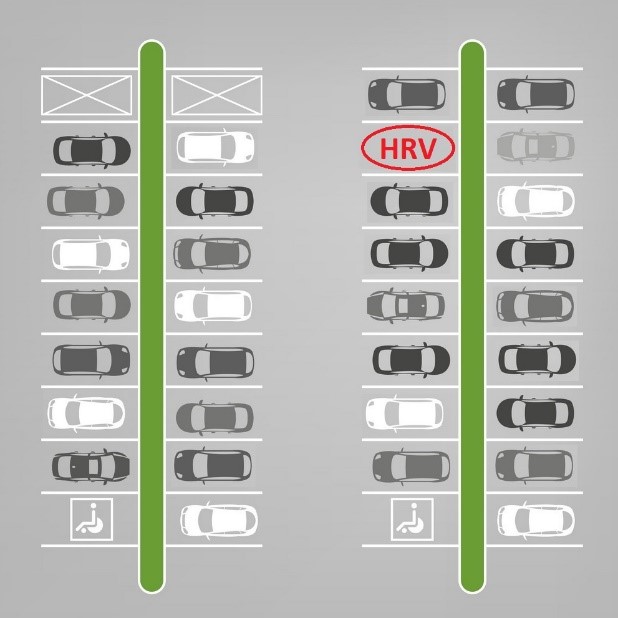
This approach to reserving orbital and frequency resources is often illustrated with the analogy of a residential building’s parking lot. For instance, each apartment owner in a building is allocated one parking space (regardless of whether they own a car). Similarly, each ITU Member State is entitled to orbital and frequency resources under the BSS Plan, the Feeder-Link Plan, and the FSS Plan.
Figure 1. Example of a parking lot and satellite orbits
In addition to the use of frequencies for satellite communications under the Plan, it is also possible to operate outside the Plan, in which case the principle of “first come, first served” applies. As a result, various countries have already substantially occupied, primarily the GEO orbit, and increasingly the LEO orbits, on a commercial basis.
BSS Plan and Feeder-Link Plan
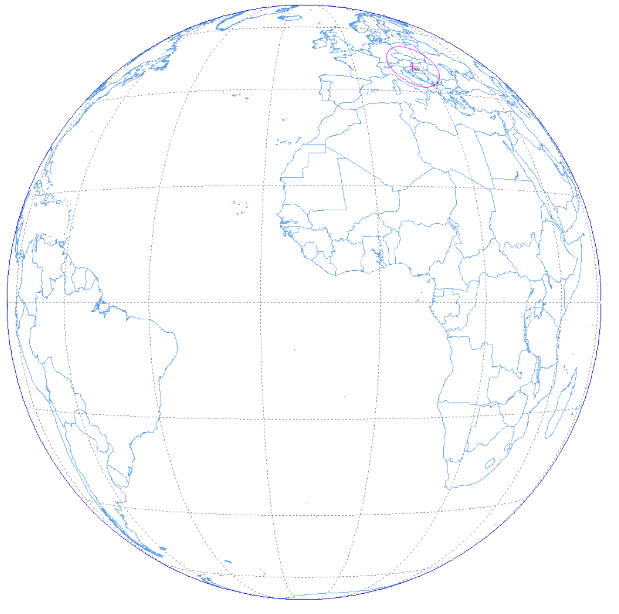
In order to exercise its rights under the BSS Plan and the Feeder-Link Plan, Croatia joined Hungary, Slovakia, and the Czech Republic. During the World Radiocommunication Conference 2000 (WRC-2000), Croatia obtained a joint assignment of the orbital position 12.8°W, within which the available frequency resources are shared equally among the four countries.The advantage of creating a joint orbital position lies in achieving a larger coverage area, which in this case encompasses all four states. The disadvantage is that the frequency resources must be shared.The BSS Plan provides for the allocation of frequencies in the 11.7-12.5 GHz band for the (downlink), while the (Feeder-Link). Plan allocates frequencies in the 17.3-18.1 GHz band for the (uplink).
Figure 2. BSS Plan - Shared Orbital Position 12.8°W
FSS Plan
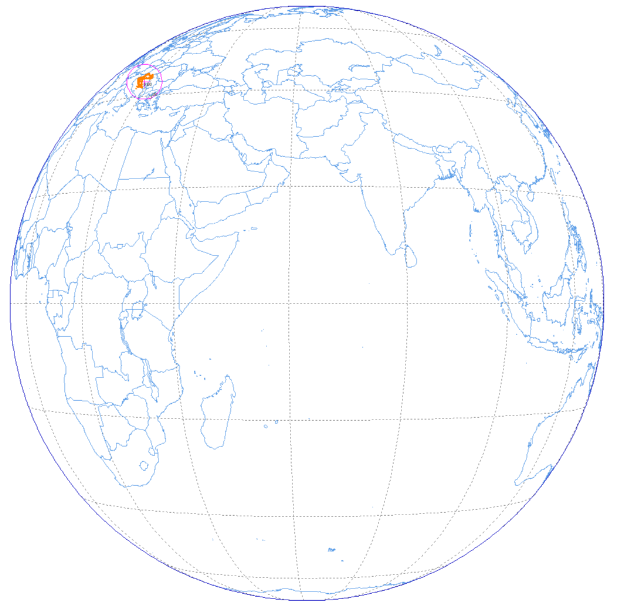
Until the conclusion of the World Radiocommunication Conference 2023 (WRC-23), Croatia did not have an assigned orbital and frequency resource under the FSS Plan. This was due to the need to resolve succession rights, as the FSS Plan was originally established in 1988 (WARC ORB-88), when the rights to the orbital position were granted to the former Yugoslavia. At WRC-23, succession rights were finally resolved, and the successor states (Croatia, Bosnia and Herzegovina, North Macedonia, Slovenia, and Serbia) were granted guaranteed rights. Croatia’s assigned orbital position under the FSS Plan is 63°E.
The FSS Plan provides for the allocation of frequencies in the following bands: Downlink: 4500-4800 MHz, 10.70-10.95 GHz, and 11.20-11.45 GHz Uplink: 6725-7025 MHz and 12.75-13.25 GHz
Figure 3. BSS Plan - HRV Orbital Position 63° E
This approach to reserving orbital and frequency resources is often illustrated with the analogy of a residential building’s parking lot. For instance, each apartment owner in a building is allocated one parking space (regardless of whether they own a car). Similarly, each ITU Member State is entitled to orbital and frequency resources under the BSS Plan, the Feeder-Link Plan, and the FSS Plan.
Figure 1. Example of a parking lot and satellite orbits
In addition to the use of frequencies for satellite communications under the Plan, it is also possible to operate outside the Plan, in which case the principle of “first come, first served” applies. As a result, various countries have already substantially occupied, primarily the GEO orbit, and increasingly the LEO orbits, on a commercial basis.
BSS Plan and Feeder-Link Plan
In order to exercise its rights under the BSS Plan and the Feeder-Link Plan, Croatia joined Hungary, Slovakia, and the Czech Republic. During the World Radiocommunication Conference 2000 (WRC-2000), Croatia obtained a joint assignment of the orbital position 12.8°W, within which the available frequency resources are shared equally among the four countries.The advantage of creating a joint orbital position lies in achieving a larger coverage area, which in this case encompasses all four states. The disadvantage is that the frequency resources must be shared.The BSS Plan provides for the allocation of frequencies in the 11.7-12.5 GHz band for the (downlink), while the (Feeder-Link). Plan allocates frequencies in the 17.3-18.1 GHz band for the (uplink).
Figure 2. BSS Plan - Shared Orbital Position 12.8°W
FSS Plan
Until the conclusion of the World Radiocommunication Conference 2023 (WRC-23), Croatia did not have an assigned orbital and frequency resource under the FSS Plan. This was due to the need to resolve succession rights, as the FSS Plan was originally established in 1988 (WARC ORB-88), when the rights to the orbital position were granted to the former Yugoslavia. At WRC-23, succession rights were finally resolved, and the successor states (Croatia, Bosnia and Herzegovina, North Macedonia, Slovenia, and Serbia) were granted guaranteed rights. Croatia’s assigned orbital position under the FSS Plan is 63°E.
The FSS Plan provides for the allocation of frequencies in the following bands: Downlink: 4500-4800 MHz, 10.70-10.95 GHz, and 11.20-11.45 GHz Uplink: 6725-7025 MHz and 12.75-13.25 GHz
Figure 3. BSS Plan - HRV Orbital Position 63° E