Every Third Child in Croatia Uses Artificial Intelligence: Do They Know How — and With Whose Support?
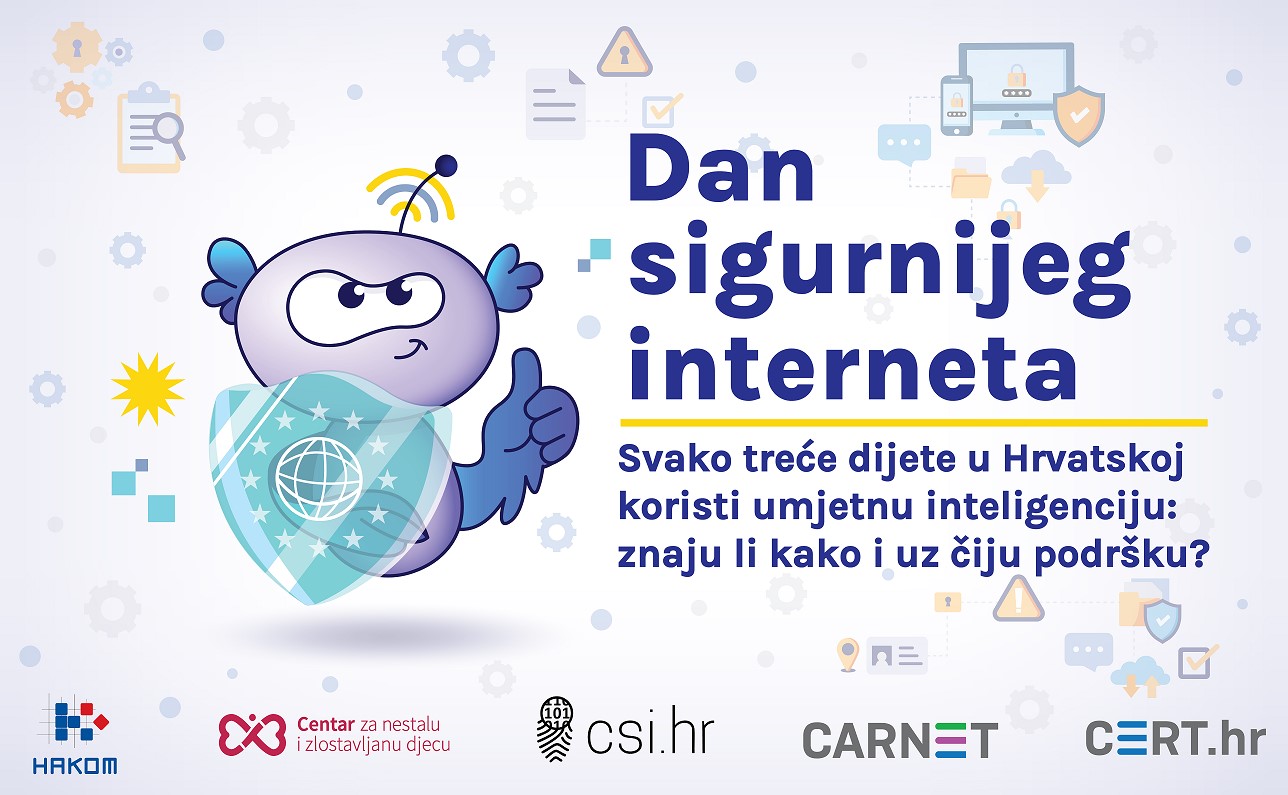 ZAGREB, 4 February 2026 - Children and youth in Croatia are increasingly using generative artificial intelligence tools in their everyday lives, primarily for schoolwork, learning and completing assignments, but also for conversations, advice and the exploration of topics that interest them. This is also reflected in the national results of international research into children’s digital habits conducted by the Association for Communication and Media Culture, which indicate that artificial intelligence tools have already become an integral part of the digital environment of children and youth.
According to the findings, almost every third child uses generative artificial intelligence for conversations and advice, while school-related activities remain the most common purpose. With the support of artificial intelligence, children write essays and stories and use these tools to explain and summarise learning content. At the same time, around one fifth of children report not having used artificial intelligence tools at all in the past month, highlighting disparities in access, knowledge and digital skills.
The use of artificial intelligence tools among children and youth will be one of the topics addressed at a conference marking Safer Internet Day. The conference, entitled “Together for a Safer Internet”, will focus on the safety of children and young people in the digital environment and will be held on 10 February in Zagreb.
“The particular value of this conference lies in the active involvement of children in dialogue, from workshops to discussions in which youth directly put questions to decision-makers. Children today are not merely internet users who need to be protected; they are active participants in the digital space and have the right to take part in shaping it,” said Miran Gosta, Director of the Croatian Regulatory Authority for Network Industries (HAKOM).
Research by the Association for Communication and Media Culture further shows that children most often use artificial intelligence for practical purposes. Thirteen per cent of children report that AI helps them complete tasks more easily, 11 per cent say it saves time, and nine per cent of respondents believe that using artificial intelligence improves their school performance.
On the other hand, among children who do not use artificial intelligence, almost 40 per cent state that they do not need it, while more than a quarter say they do not know enough about these tools to use them.
At the same time, some children express concerns: around 16 per cent worry about privacy and the sharing of personal information, while 12 per cent believe that artificial intelligence can provide inaccurate or fabricated information. This divided picture clearly highlights the importance of not only protecting children but also empowering them with the knowledge and skills to use new technologies responsibly.
“Artificial intelligence is no longer a topic of the future; it is already part of children’s everyday lives. They use it spontaneously, often without clear guidance, while adults are frequently slow to understand these tools. It is our responsibility to ensure that children use artificial intelligence safely, critically, and to their benefit rather than to their detriment. This is achieved through conversation, education, and clearly defined rules,” added Tomislav Ramljak, Executive Director of the Safer Internet Centre.
The conference marking Safer Internet Day will bring together representatives of institutions, experts in education, healthcare, communications and digital security, as well as children and youth, who will actively participate in the discussions. The programme includes the presentation of the results of a national study on online sexual abuse, debates on policies aimed at ensuring a healthy online environment, the code of conduct for protecting children’s rights in the digital space, challenges in communication within the world of social media and artificial intelligence, as well as workshops designed for both children and adults.
“Our aim is to raise awareness among children, parents, and education professionals about new digital tools, as well as the importance of safeguarding children online. Experts from the National CERT cover topics such as creating secure passwords, protecting personal data, understanding the digital footprints we leave behind, and recognising potential online threats. Through the BrAIn project, CARNET has also developed artificial intelligence curricula, which are already being implemented in primary and secondary schools, helping students develop critical skills for the safe and responsible use of digital technologies,” said Miro Đuzel, Deputy CEO for National CERT.
The conference marking Safer Internet Day 2026 will be held in Zagreb, organised by HAKOM, the Centre for a Safer Internet, and CARNET’s National CERT. The full conference programme is available via the following link, and the link for online participation will be published shortly before the event.
For additional information please contact:
Croatian Regulatory Authority for Network Industries (HAKOM)
- Roberta Frangeša-Mihanovića 9 Street
- 10110 Zagreb, Croatia
- Tel. + 385 (0) 1 700 70 07
- Fax + 385 (0)1 700 70 70
Media inquiries can be submitted online using HAKOM’s official website: www.hakom.hr
About Hakom
HAKOM - Croatian Regulatory Authority for Network Industries – ensures preconditions for a fair market competition, stable growth and environment for innovations in the electronic communications and postal services market. HAKOM protects users’ interests and the possibility of choice among various communications and postal services at affordable prices, defines sustainable competitive conditions for operators and service providers under fair conditions for return on investment, and provides support to economic growth, public services and the quality of life in the Republic of Croatia by using modern technologies. HAKOM’ strategic goals are: to promote regulation of the electronic communications and postal services market, to support growth of investments and innovations in the electronic communications and postal services market, to provide efficient use of limited resources, to accelerate the growth of broadband products and services, to provide affordable offers of communications and postal services, to provide protection and informing of users, to build an efficient and comprehensive information system, to define and implement efficient processes, and to acquire multi-disciplinary expertise in market regulation.